In this section of the book, the reader has just been introduced to the backstory of the protagonist, Quasimodo. This part is important because it gives the audience a sense of how significant Claude Frollo is to the life of Quasimodo. Claude Frollo gave Quasimodo everything he had; he took Quasimodo in when no one else wanted him or dared to looked at the boy people referred to as a"monster. Claude Frollo had even been the person who had introduced Quasimodo to his precious bells, objects that he loved with a passion as if they were his own children. Because of these things, Quasimodo owed his life to Claude Frollo, and everyday was repaying that as Frollo's personal slave. At the beginning of the story, Claude Frollo had also been the only human being Quasimodo ever had communication with, showing how heavily Quasimodo relied on Claude Frollo's influence. Quasimodo lived to please Claude Frollo, and later in the book the reader sees how this affects his decision-making when he is unable to stand up for himself against his master. In the future, Claude Frollo makes many unethical decisions which Quasimodo is unable to get the courage to stop, and in some cases even aides Claude Frollo in his evil plots.
"I thought... that a trial would deliver you into my power, that in prison I should possess you; that there, you could not escape me. Since you had possessed me so long, I desired to possess you in my turn. When one thinks evil, one may as well consummate it. 'Tis madness to stop midway! The extremity of crime has its delirium of joy. A priest and a witch may join in ecstasy upon the straw of a dungeon floor!" (324)
This is a turning point in the book. Here the reader learns that the misfortunes that had fallen upon Esmeralda, the beautiful young gypsy, including the torment she received for performing, her attempted kidnap, the attempted murder of her love, and her current imprisonment had all been caused by Claude Frollo. Claude Frollo had just confessed his love for Esmeralda, an unexpected event for her considering that she had never met this man nor knew who he was. Here, the reader reaches a crucial point in the story, discovering that Claude Frollo's love for Esmeralda has been the cause of her doom. Claude Frollo was no longer of sane mind, and now believing he was due for eternal damnation for giving into the temptation of women against the vows he had made as a priest, was now undoubtably evil. He blamed Esmeralda as the devil who has tempted him, and now, in his twisted mind; has put her in a predicament where her only choices are to love Claude Frollo and be saved, or refuse him and be hung the next day. In his twisted scheme, Claude Frollo uses loving him as the only method of survival for Esmeralda.
"At the most dreadful moment, a demoniacal laugh, a laugh such as can come only from one who is not human, burst from the livid face of the priest. Quasimodo didn't hear the laugh, but he saw it. The bellringer took a few steps back from the archdeacon, and then, rushing at him furiously, with his two huge hands, he struck the priests back and pushed Dom Claude into the abyss over which he had been leaning." (494)
Here, we find Quasimodo and Claude Frollo at the top of a tower of Notre-Dame. Quasimodo has followed Claude Frollo up to the top to investigate what has become of Esmeralda, who had earlier that day been kidnapped by Claude Frollo. Claude had been waiting up there, a place with a great view of Paris. He was watching the Place de Greve, where one could see a hanging was about to take place. Here Quasimodo watched in horror as he realized it was Esmeralda that was about to be hung. Both Quasimodo and Claude Frollo watch as their love falls to her death, though their reactions are very different. Claude Frollo is joyful and relieved that his temptress is gone, while Quasimodo is full of sorrow and anger that such a pure, good, woman whom he only wanted to protect was now gone all due to the other person dear to Quasimodo's heart, Claude Frollo. This had set Quasimodo over the edge; he was no longer able to ignore the evil doings of his master. He killed the only other person left in the world whom he had loved. Very important to the story, Quasimodo had finally stood up against his master, breaking away from this oppressive power to punish the one who had brought so much pain to others for his own selfish thoughts of love and lust.
Connections:
One connection I can draw from the text to what I see in the world today is how easily people fall in love, or at least think they are in love, though it might only be lust. It is astonishing to see how many characters in this book fall so easily in love. Esmeralda fell in love with an officer named Phoebus, simply because he was a handsome man who had saved her from being kidnapped. Even though this officer only wanted to use Esmeralda for sex, Esmeralda took his empty confessions of love to heart and is for the rest of her life devoted and insistent on loving only him. When the officer's plans to bed with her go awry, he soon forgets about her while she is permanently stuck loving this man. Dom Claude also quickly falls in love with Esmeralda, though he knows nothing about her but her beauty and great voice. I believe he mistakes his strong lust for love, but nevertheless he still stalks Esmeralda and confesses his unyielding love for her over and over again. Quasimodo also quickly falls in love with Esmeralda after she does him an act of kindness, though I do not know if this more of a sisterly love or a romantic love. I see these sort of quick attachments or confession in love often today whether it be on television or in real life. I think it is quite a frequent occurrence for people to mistake a great attraction or feeling of lust for love. I think it is even more common in teenagers, who seem to easily "fall in love" as hormonal, naive, and eager to grow up as many of them are. I often hear couples of my age professing their love for each other, though I doubt most are truly in love whether they believe so or not.
Another connection I can make from the book to the world today is how important looks are to society. Esmeralda loves the officer because he is handsome and strong, while she would never even considered Dom Claude even if he had not been an insane evil man because he was not good-looking and was old. Because of Quasimodo's appearance he was called a monster and avoided by everyone though he was someone of the kindest heart. Dom Claude falls in love with Esmeralda solely on her looks since he had never met her beforehand, and because of her beauty she had also attracted Phoebus. It is a pity how reliant everyone is on appearance, where personality always comes second to this. It is also true for today that appearance is a critical factor for how people are judged, and will most likely always continue to play a significant factor. I'd like to think, though, that people are good enough to realize that appearance is not the most significant factor of defining a person, and what their character is like is much more important, especially when looks fade away with time.
The last connection I can make between the book and the world today is the theme of jealousy. In The Hunchback of Notre-Dame , Dom Claude is unable to win over the heart of Esmeralda. His reaction to this is very unsettling. He takes on the attitude of "If I can't have her, no one can" and his resolution is to kill her as punishment for not loving him. I think we all have at one point indulged in this selfishness, where in jealousy we take on the attitude of "if I can't be happy, no one can," though probably not to the extreme of Dom Claude. It is easy to get caught up in ourselves, but we must try not to hurt others in the process and should try to keep their best intentions in mind as well, an act of kindness Dom Claude failed to do.
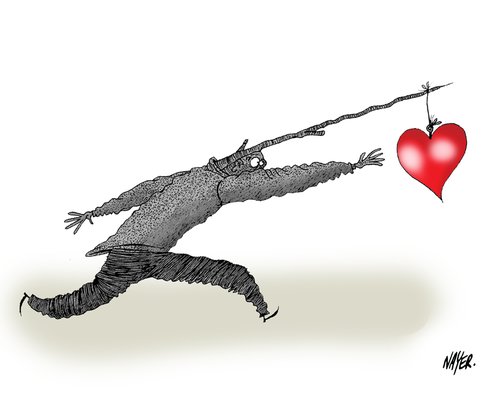
In this image love is always out of reach for the man no matter how hard he tries to catch it. This relates to the book because no character's love is reciprocated. They are all chasing characters who have never felt love towards these people. Esmeralda did not love Dom Claude or Quasimodo, and Phoebus did not love Esmeralda. All of them are chasing what they cannot have.
Discussion Questions:
Why did Quasimodo show so much kindness and love towards Esmeralda?
What would be the future of Phoebus and Esmeralda if Dom Claude had not tried to kill him?
Why did Dom Claude find the need to stalk Esmeralda and ruin her life? Why did he not find a new subject of his affection?
Why kind of love did Quasimodo feel for Esmeralda? (romantically or sisterly)
Why did Phoebus so easily let a threatening stranger enter his room to watch him seduce a woman? Had he no dignity or fear?
Reflection:
Overall, this did not end up being a favorite for me. There were some parts I enjoyed like how well Hugo does at developing each character, even the meager ones, and how intriguing the story line is for being so crazy and chaotic, but even these parts that I like are still reasons that I disliked this book. Hugo developed the characters so well and was quickly able to help the reader connect with a character, but there were too many characters, too many names, too many stories with stories. Overall there was just too much going on, a lot was unneeded like the story of Esmeralda finding her long-lost mother. i thought this was too predictable and cheesy, the story could have done without it. The story was also too crazy to the point of ridiculous; it wasn't realistic and therefore not as easy to connect to. I can see why in its time, it had been made fun of by literary critics since it is less of a book with great substance and message, it is more like a really complicated drama. I also did not like such a depressing and unsettling ending, it definitely did not leave me with a good feeling about the book. I also didn't like how disconnected the book was. The book is made up of little stories focusing on different characters, so the reader often is in the middle of something interesting point in the plot when it switches to a new part of the story, not returning back to the point one was at for many chapters. The biggest annoyances I had with this book were these two large chapters of rambling that had nothing to do with the plot. One of these chapters was about the geography of Paris, which was completely useless to me because it mentioned all these different names of places I wasn't going to remember and the second rambling chapter was about how the invention of the printing press made architecture less beautiful because the printing press creating an easier and cheaper method of showing off the culture of an era, so they didn't need to try as hard to express this in architecture. While The Hunchback of Notre-Dame was an entertaining novel, for many reasons explained above I do not feel that it is one that deserves great praise.

No comments:
Post a Comment